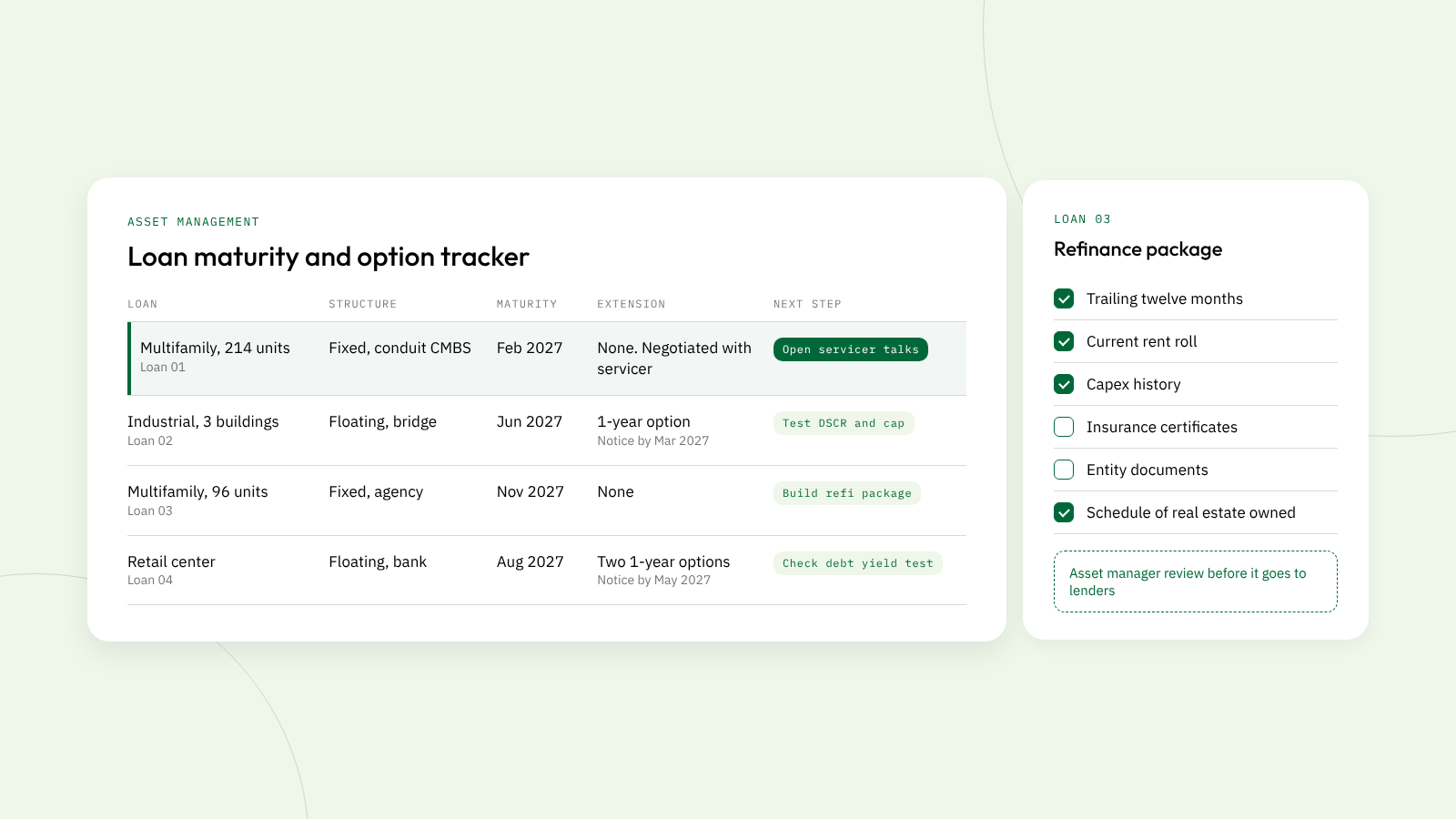
Before a loan matures, an asset management team should hand off the desk work that keeps the loan file current and hold on to the decisions. The work to delegate is the maturity and extension calendar, the refinance package, servicer reporting, the lender quote log and the logistics of any capital call. The asset manager keeps the choice between refinancing, extending, paying down or selling, along with every conversation with the lender, the servicer and the investors.
What changed in September
The September rate hike widened a refinancing gap that already existed. CRED iQ resized $136 billion of Fannie Mae, Freddie Mac and CMBS apartment loans maturing between October 2026 and December 2028. Before the hike, 21% of those loans couldn't refinance at a 1.25x coverage test without new equity. After it, 23% couldn't, holding 31% of the balance, and the equity needed rose to $6.8 billion. The median shortfall is 15% of the loan. Loans written in 2021 and 2022 are the worst off, with 46% of them short (CRE Daily, October 16, which notes CRED iQ labeled its September figures preliminary; Commercial Observer, October 19).
Walker & Dunlop CEO Willy Walker said on CNBC that lenders still have money, and that the open question for 2027 is who supplies the equity (CRE Daily, October 13). Morningstar Credit reported that a Blackstone apartment CMBS loan, originally $1.3 billion and now down to $517.7 million on six remaining properties, went to special servicing after its October maturity, with a three-month forbearance to sell what's left (CRE Daily, October 21).
For the team working a maturity, a loan that pencils on refinance takes one round of lender calls. A loan that comes up short takes several rounds and a fallback plan, and it usually ends in a call to investors, so a maturity calendar carries more hours when more of its loans are short.
How to split the work
Each piece of maturity work has an assembly side a support person can carry and a decision that stays with the asset manager.
- Maturity and option calendar. A support person builds and maintains one tracker, pulled from the loan documents, with every maturity date, extension option and notice window, the conditions attached to each extension, and rate cap expiration dates. Whether to extend, and on what terms, is the asset manager's decision.
- Refinance package. The support person assembles the trailing twelve months, the current rent roll, the capital expenditure history, insurance certificates, entity documents and the sponsor's schedule of real estate owned, formatted the way your debt broker or lender asks. The business plan, and the story the numbers tell, belong to the asset manager.
- Servicer reporting. The support person sends the quarterly operating statements and rent rolls the loan documents require on time and logs every servicer request and response. Anything that starts to read like a negotiation goes to the asset manager.
- Lender quote log. Support keeps an internal record of who has the package and what came back, and checks the broker's quote matrix against each term sheet for proceeds, rate, term, amortization, reserves and prepayment. The asset manager picks the quote to pursue and decides which terms to push on.
- Investor logistics. The support person drafts the capital call notice from your template, tracks who has funded and logs investor questions for a reply. Whether to call capital at all, and the conversation with each investor about it, stays with the asset manager.
Build the calendar before anything else
The maturity and option calendar is the place to begin. Building it takes less effort than anything else on the list, and a missed notice window on it can take an extension option off the table.
The tracker has to tell two kinds of loans apart. Floating-rate bridge, bank and single-borrower loans often carry contractual extension options, each with a notice window and conditions such as a coverage or debt yield test, a new rate cap and an extension fee. Fixed-rate agency and conduit loans generally have no option to exercise. Any extension on those gets negotiated, and on a conduit CMBS loan the counterparty is the servicer, which usually means a transfer to special servicing first. For those loans, the date the tracker needs is when to open that conversation.
Give your support person the loan agreements and any modifications and ask for one tracker covering every loan on the books. Check it line by line against the documents before you rely on it. From there the work is upkeep. A modification changes the dates, a paydown changes the math on the extension tests, and a new rate cap brings its own expiration, so each of those changes needs an owner who updates the tracker the day it happens.
The refinance package makes a sensible second handoff. The same package goes out for each loan and to each lender, and every figure in it ties back to the property's books, so checking it is straightforward. Give the rent roll extra attention; our rent roll task page covers what a clean one includes.
Who to look for
Look for someone who reads documents carefully. A good interview exercise is to hand the candidate an extension clause and ask which dates and conditions they'd pull from it. A software list on a resume won't show you that.
Expect plenty of questions in the first two weeks, and set aside a few minutes each day to answer them. Most are about format or about which version of a document is current. Settling each one early stops the same mistake from repeating across the loan book.
A team with only one or two loans maturing in the next two years may not need a new person. A shared calendar, a package checklist and an hour a week from someone already on staff can cover it. Dedicated support makes more sense as the loan count grows, along with the lenders and investors behind it.
Investor logistics overlap with investor relations work, and our investor relations assistant page covers what that role owns.
Using AI on loan files
AI tools can pull dates and conditions out of a loan agreement, summarize a trailing twelve months and put several term sheets side by side in a few minutes. They also miss things, and the misses are easy to overlook. An extension condition buried in a modification can be left out, a rate quoted as a spread can come back as an all-in rate, and a reserve requirement can drop off a comparison with nothing to show it's gone. A person should check anything an AI tool produces from a loan document against the source before anyone acts on it, including every figure headed into a sizing model.
For more on hiring support alongside AI tools, see scaling a CRE team with AI. If rising rates are also adding work on the closing side, when to hire a transaction coordinator covers that role.
Working with Scale Partner
Scale Partner places VAs with commercial real estate teams to handle desk work like this. Each VA is trained before their first day, is productive in your tools on day one, works for one client at a time and comes with a 14-day replacement guarantee. Average tenure runs past twelve months. We also build and maintain agents configured to each client's market, financial models and internal workflows, delivered through the placed VA in the tools the team already uses. The review step described above applies to their output the same way it applies to anyone's. The support roles we place are listed on the roles page, and how it works covers the rest.