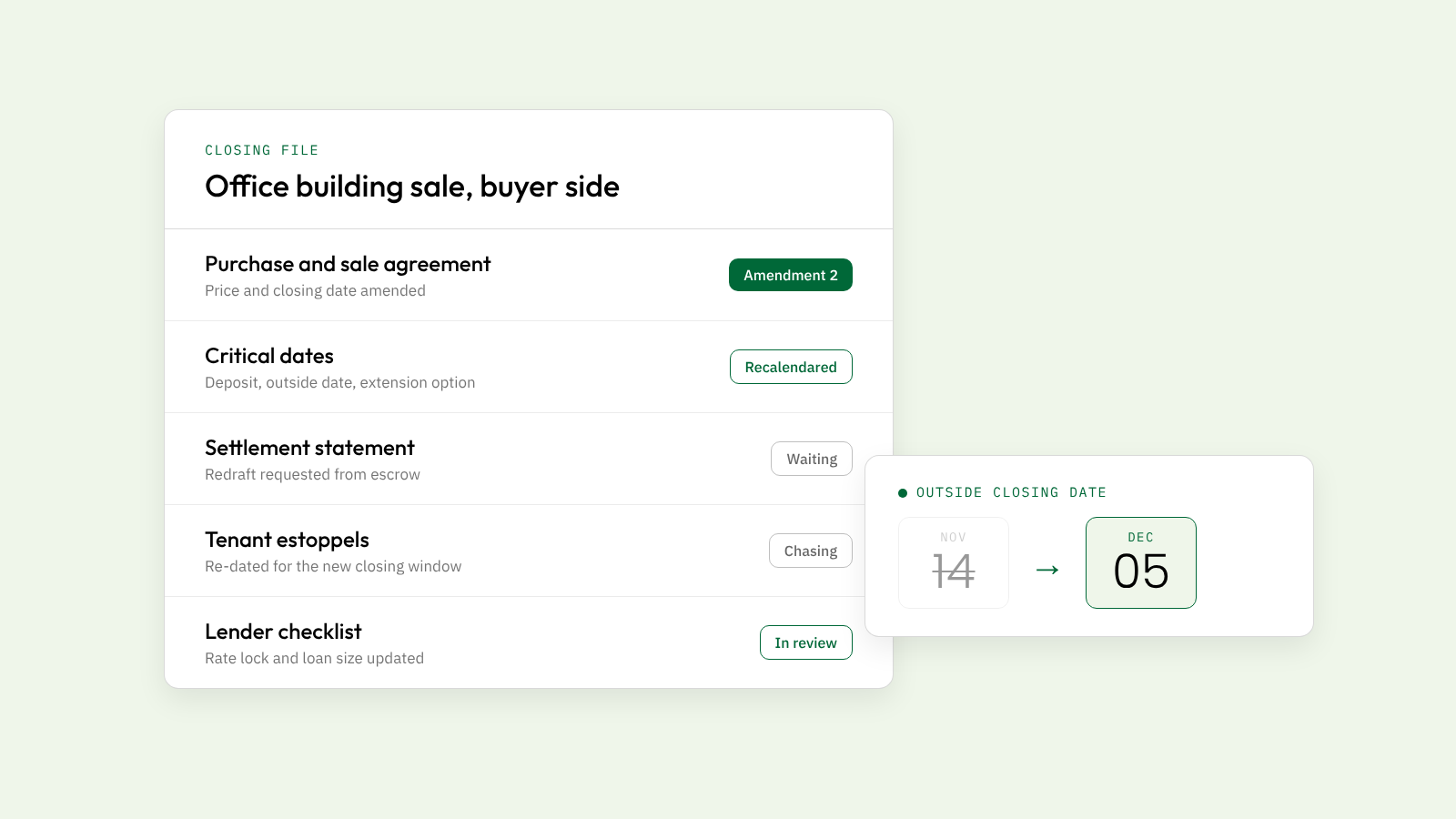
Hire a transaction coordinator when the people who negotiate your deals are spending their hours keeping closing files current: tracking purchase agreement deadlines, chasing estoppels and third-party reports, and re-checking the settlement statement after every amendment. Right now, with buyers retrading contracts as rates climb, that work is growing faster than deal count.
This month, closing got harder
The deals are still there. Getting them to the closing table takes more work than it did in the summer.
As rates rose between contract and close, buyers went back to sellers for price cuts and threatened to walk if they did not get them. In one case reported this week, a buyer took $600,000 off a $20 million apartment deal after financing costs moved. A Marcus & Millichap executive put it plainly: "We are working harder to close deals now than we ever have before." (Investing.com, October 6)
The lending side tells the same story. CMBS special servicing reached 11.42% in August, its highest level since February 2013, according to the same report.
None of that shows up as a new line on your pipeline report. A retrade is more work inside a deal you already counted, and it lands on whoever happens to be holding the file.
What a retrade adds to the closing file
Agreeing on a new number is the principal's job, and it can take a single phone call. Everything that follows is coordination, and it touches nearly every document in the file:
- The amendment itself. A new price, a new credit or a new closing date has to be papered, signed by both sides and filed with every prior amendment.
- Critical dates. If closing moves, so do the deposit deadlines, the outside date and any extension options. Each one has to be recalculated from the amended agreement and recalendared.
- The settlement statement. The draft from escrow or title was built on the old terms. Every changed line has to be traced back to the amendment before anyone signs.
- The lender. A buyer with new financing may need a resized loan, an updated rate lock or a revised appraisal timeline, and the lender's closing checklist moves with it.
- Tenant estoppels and third-party reports. Many purchase agreements require estoppels dated within a set window before closing. Push the date far enough and some tenants have to be asked again.
- Everyone who needs to know. Counsel on both sides, the title company, the escrow agent, the lender and your own team all need the new terms, and they need the same version.
A deal that is retraded twice runs through that list twice. In a market where buyers are using a rate move as leverage, a second ask is more likely than usual.
Signs your team needs a dedicated coordinator
You can usually see the need before you can measure it. Look for these:
- Deadlines live in someone's inbox. If the only record of an outside date is an email thread, nobody owns it.
- A date was missed, or nearly missed. One close call on a deposit going hard is enough evidence.
- Settlement statement errors are caught late. A wrong proration found the morning of closing means nobody had time to check it earlier.
- Senior people are chasing paperwork. When a broker or an acquisitions lead is the one following up on an estoppel, the most expensive hour on the team is doing the cheapest work.
- Hours per deal are rising while deal count holds. This is the pattern retrades create, and it is the clearest signal of all.
Two or more of these, on a steady flow of deals, is the point where the work justifies its own owner.
When you should wait
A coordinator is the wrong answer in two situations.
If your team closes a handful of deals a year, a good closing checklist and a strong title company or closing attorney may cover it. The coordination load is real but intermittent, and a full role would spend most of its week waiting.
If the problem is the negotiation itself, a coordinator will not fix it. Deciding whether to accept a retrade, how hard to push back and when to let a buyer walk are judgment calls for the principal. A coordinator makes those calls cheaper to carry out once you have made them.
What the role should own
Write the split down before the first day, because the line is easy to blur once someone is helping.
The coordinator owns: the critical dates calendar, built from the signed agreement and every amendment; the closing document checklist and its status; chasing estoppels, reports and signatures; keeping one current version of every document; and a short status note to the deal team each week, or each day in the final stretch.
The principal or counsel owns: negotiating any change to terms, approving any waiver of a closing condition, and signing off on the final settlement statement. The coordinator flags every line that does not trace to the agreement. A person with authority over the deal decides what to do about it.
How to hand it off
Start on a new deal at signing. Taking over a file mid-stream means reconstructing history, and the first deal should be a clean test. Pick the next agreement that executes.
Build the checklist from the agreement, with section numbers. Every deliverable, every condition, every deadline, each tied to the clause it comes from. That is what lets the coordinator rebuild the checklist quickly when an amendment lands.
Make every amendment a trigger. The day an amendment is signed, the coordinator recalculates the dates, updates the checklist and tells every party. Agree on this rule up front, so a retrade sets off a routine everyone already knows.
Give access that matches the job. The deal folder, the shared calendar, and a copy on correspondence with title, escrow and the lender. Signing authority and wiring instructions stay exactly where they are.
Cover the right hours. Title companies, escrow agents and lenders work business hours in the property's time zone. Whoever holds the role needs to overlap with them, wherever that person sits.
This is desk work from start to finish, so it suits a remote hire as well as an in-house one. What matters is that one person owns the file. See how the transaction coordinator role is scoped, and how it fits with the other support roles we place.
What your deal team gets back
When the closing file has an owner, retrades stop costing the deal team its week. Brokers and acquisitions leads spend their hours on the next deal and on the judgment calls in the current one. Deadlines are tracked against the signed agreement. The settlement statement gets checked before closing morning. For more on deciding which work to hand off first, see scaling a commercial real estate team with AI.
Put an owner on every closing file
Scale Partner places transaction coordinators and other support professionals with commercial real estate firms. Every placement has 3+ years of relevant professional experience, is college educated and speaks fluent English. They are trained before their first day and productive in your tools on day one, and one VA serves one client at a time. Scale Partner is the employer of record, average tenure runs past twelve months, and every placement comes with a 14-day replacement guarantee.
Scale Partner also builds and maintains its own agents, configured to each client's internal workflows and delivered through the placed professional inside the tools your team already uses. Anything an agent drafts against a purchase agreement or a settlement statement needs a person's review before anyone acts on it. Browse the CRE task guides for how that split works on closing work.