The data on AI in commercial real estate heading into 2027 says adoption is close to universal and results are still rare. JLL found 88% of investors and owners piloting AI and only 5% of occupiers hitting all their program goals. Deloitte found 92% of firms still researching or piloting. Every major survey names the same blockers: messy data, untrained staff and missing review controls. Each of those is work a person has to do every week, which makes AI in 2027 a staffing question as much as a software one.
What the surveys say about adoption
Six data sets published over the past year cover AI in commercial real estate from different angles.
- JLL's 2025 Global Real Estate Technology Survey polled more than 1,500 senior investors and occupiers across 16 markets. 88% of investors, owners and landlords had started AI pilots, up from fewer than 5% of companies in July 2023. Only 5% of occupiers had achieved all their program goals, and most respondents were running about five use cases at once (JLL, October 2025).
- Deloitte's 2027 Commercial Real Estate Outlook surveyed 950 executives at firms with at least $250 million under management in June and July 2026. 92% are in the research or pilot phase and 8% have integrated AI solutions. Almost half have agentic AI running in some live production workflow, and a little more than half are seeing incremental operational gains (Deloitte).
- NAREIM's 2026 Technology, Data and AI Survey covered 38 institutional real estate firms. 91% have deployed Microsoft Copilot. Asked to rate themselves out of 10, firms scored their AI maturity at 5.7, their data quality at 6.2 and their governance readiness at 5.1 (NAREIM, April 2026).
- RICS's 2026 AI report included 1,265 commercial property professionals worldwide. More than three quarters use AI in some form, 29% use it regularly in specific processes, and 6% report widespread or full use (RICS, August 2026).
- The U.S. Census Bureau's business survey, as analyzed by the Federal Reserve, put AI use at about 24% of real estate and rental and leasing firms at the end of 2025, compared with about 18% of all U.S. businesses (Federal Reserve, April 2026).
- Dealpath's survey of institutional investors found document analysis (67%), portfolio monitoring (61%), investment memo creation (56%) and OM extraction (49%) as the most common current uses (Dealpath, September 2025). Dealpath sells AI software to the same buyers, so read its figures with that in mind.
The headline numbers look contradictory until you notice what each one counts. The Census figure counts businesses, and small ones adopt more slowly. RICS and NAREIM count whether people use a tool at all. JLL and Deloitte separate starting a pilot from finishing one. Read that way, the pattern holds across all six: AI tools are in nearly every firm, and very few firms have them built into a workflow that runs every week.
Where the value is supposed to come from
Morgan Stanley Research analyzed 162 REITs and commercial real estate services firms and estimated that 37% of real estate tasks could be automated, worth up to $34 billion in operating efficiencies by 2030. Most of that comes from labor. Brokers and services showed the highest potential gain, and the most exposed job categories included management, sales, and office and administrative support (Morgan Stanley, July 2025). Earlier, McKinsey put generative AI's potential value to real estate at $110 billion to $180 billion, with the condition that firms change how they operate to capture it (McKinsey).
Put those estimates next to the use-case data and they point at the same place. The value sits in desk work: reading documents, pulling figures, assembling memos and reports, keeping portfolio data current. That desk work is also where pilots stall.
Why pilots stall
Each survey lists its barriers differently, and three show up in nearly all of them.
The data isn't ready
Data quality and availability was the top barrier for commercial property respondents in the RICS report. JLL found 81% of respondents have at least three existing systems that aren't delivering what they expected, and more than 60% have basic technology problems to fix before they can use AI fully. NAREIM's members rated their own data quality at 6.2 out of 10. In practice this looks familiar: rent rolls in five formats across six properties, a CRM with three records for the same owner, and T-12s mapped to different charts of accounts. An AI tool reading that material produces output that looks confident and is often wrong.
Most people haven't been trained
Only 33% of the workforce in JLL's survey felt adequately trained on AI. Internal expertise gaps were the most cited barrier in Dealpath's survey, at 43%. A construction respondent in the RICS report described a version of the problem that applies just as well to property teams: newly qualified staff who are already using AI, "but implementing and blindly trusting it."
Nobody owns the checking
Fewer than half of Deloitte's respondents have put stronger controls in place, such as exception handling or a second model checking the first. NAREIM's members scored their governance readiness lowest of the three measures, at 5.1. A pilot can run without controls. A workflow that feeds an underwriting model can't.
What it means for staffing in 2027
All three blockers come down to recurring work. Someone has to keep source documents and data consistent. Someone has to run the tools on the weekly work against a written standard. Someone has to check the output against the source before anyone uses it. On most teams that work belongs to whoever has a spare hour, which in a busy quarter means nobody.
The firms in Deloitte's survey seem to know it. 67% ranked AI and data fluency as the top capability for rising leaders, and 54% expect leadership skills to change significantly within 12 to 18 months. That fluency gets built by doing the work, and a team gets more from AI in 2027 by naming who does it than by adding another tool.
When you hire or assign someone to this, look for a careful reader who writes procedures down and flags what doesn't match. One useful interview exercise: hand the candidate an AI-generated rent roll summary with two planted errors, along with the source rent roll, and ask them to check it. You'll learn more from that than from a list of tools on a resume.
A team running one tool on one workflow may not need a new person at all. An hour a week from someone already on staff, with a written checklist, can cover it. Dedicated support makes more sense once several workflows run every week and the output feeds decisions with money attached.
The review step, in practice
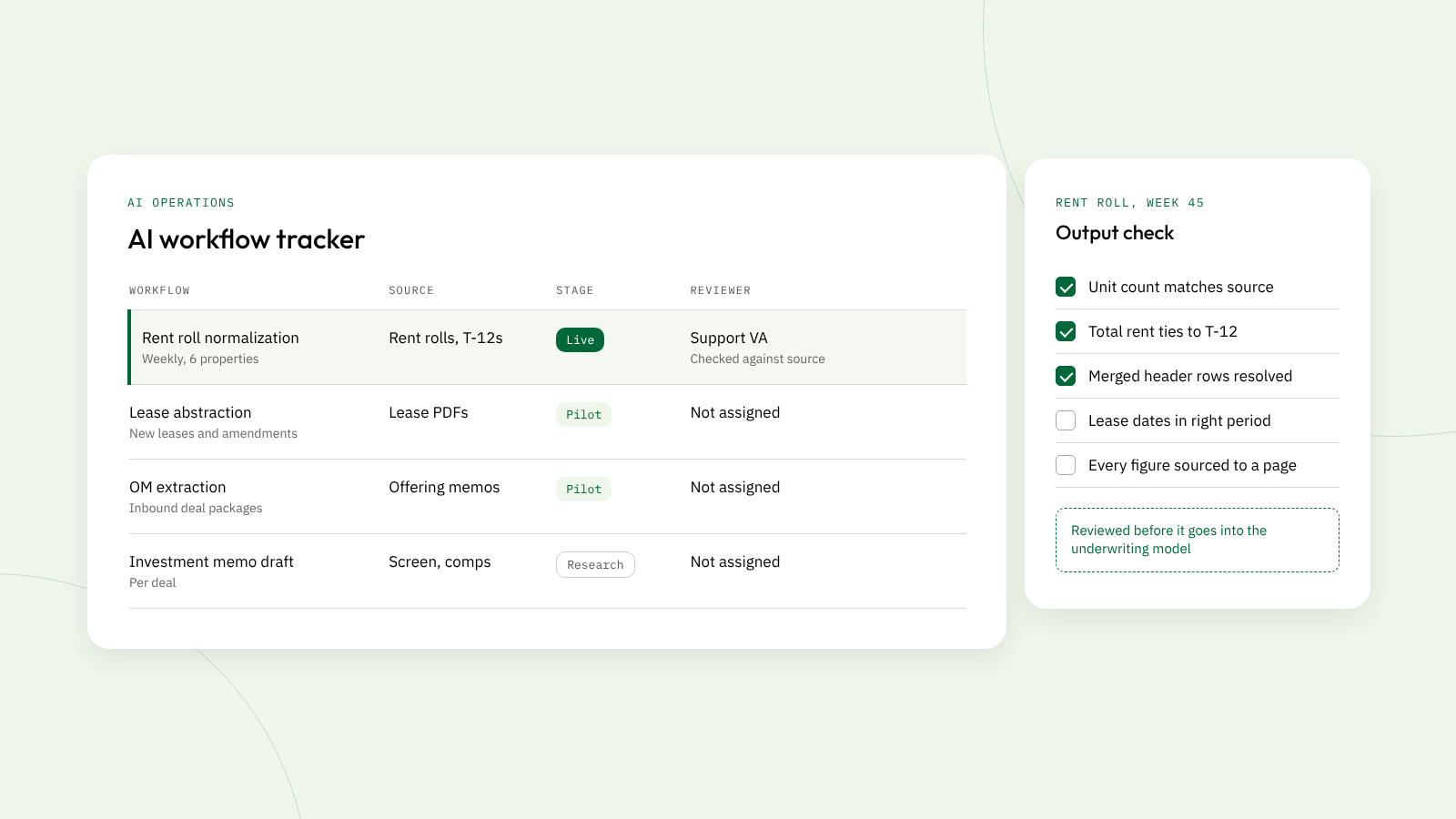
AI tools can pull terms from a lease, line items from a T-12 or units from a rent roll in minutes. They also miss a clause the prompt didn't anticipate, misread a merged header row, carry a figure into the wrong period or drop a line without any sign it's gone. Before anyone acts on AI output from a lease, rent roll or financial statement, a named person compares it with the source document, and each figure bound for an underwriting model carries a page reference back to where it came from. For what a clean rent roll should contain, see our rent roll task page. Our deal flow guide shows how to set up a screening workflow and check its output. For how to sequence AI and hiring on a growing team, see scaling a CRE team with AI.
Working with Scale Partner
Scale Partner's VAs take on this recurring AI work for commercial real estate teams. We build and maintain the agents ourselves, configured to each client's market, demographics, financial models and internal workflows, and the placed VA runs them inside your existing tools with no new software to adopt. Checking the output against the source is part of the VA's job from the start. Each VA is productive in your tools on day one because training happens before their first day. One VA serves one client at a time, every placement carries a 14-day replacement guarantee, and average tenure runs past twelve months. See the roles we place or read how it works.